

Can Marble Floors Be Repaired? Yes - Here’s How
- brigi rodriguez

- May 22
- 6 min read
A marble floor can go from elegant to tired faster than most owners expect. One spill, years of foot traffic, furniture movement, or the wrong cleaner can leave the surface dull, etched, scratched, or stained. The good news is that can marble floors be repaired is usually a yes - and in many cases, the floor can be restored far more successfully than people assume.
What matters is the type of damage, how deep it goes, and whether the repair is handled like true stone restoration instead of basic cleaning. Marble is a natural material, and it responds best to specialized processes that correct the surface rather than just cover the problem.
Can marble floors be repaired in every case?
Not every marble floor has the same repair path, but many common issues are fixable. Surface scratches, light etching, traffic wear, dullness, and minor staining are often very repairable. Even some cracks, chips, and uneven areas can be corrected or improved significantly.
Where things become more complicated is when the stone has severe structural damage, deep breakage, major subfloor movement, or long-term neglect that has weakened the tile. In those situations, repair may still be possible, but the work can involve more than polishing. It may require filling, grinding, resetting tiles, or selective replacement.
That is why the real question is less can marble floors be repaired and more what kind of repair will produce a durable, attractive result.
The most common marble floor problems
Marble is beautiful, but it is softer and more reactive than many property owners realize. It can scratch from grit on shoes, etch from acidic liquids, and lose shine in high-traffic paths. In homes, that often shows up in kitchens, entryways, and main living areas. In commercial settings, lobbies, hallways, and customer-facing spaces usually show wear first.
Etching is one of the biggest sources of confusion. Many people call it a stain, but etching is actually surface damage. Acidic products or spills change the finish of the stone, leaving dull, light, or cloudy marks. Since the surface itself has been altered, simple cleaning will not remove it.
Scratches are another common issue. Fine scratches may only affect the finish, while deeper ones can catch light and stand out across the floor. Chips along edges and corners are also common, especially where heavy objects have been moved across the tile.
Then there is general loss of shine. This usually happens gradually. The floor still looks clean, but it no longer reflects light evenly. That kind of wear is often a sign that the marble needs professional honing and polishing rather than another coat of wax or a stronger cleaner.
What professional marble repair usually involves
A proper repair starts with identifying whether the damage is cosmetic, functional, or structural. That determines the process.
For dullness, light scratching, and etching, the standard solution is honing and polishing. Honing removes a very fine layer of stone to level out surface damage. Polishing then restores clarity and gloss, whether the goal is a soft satin finish or a high-shine appearance.
If the floor has deeper scratches or lippage, which is uneven tile height from one piece to the next, grinding may be needed. This is a more aggressive correction step and should be handled carefully, especially on natural stone. Done correctly, it can dramatically improve both appearance and smoothness.
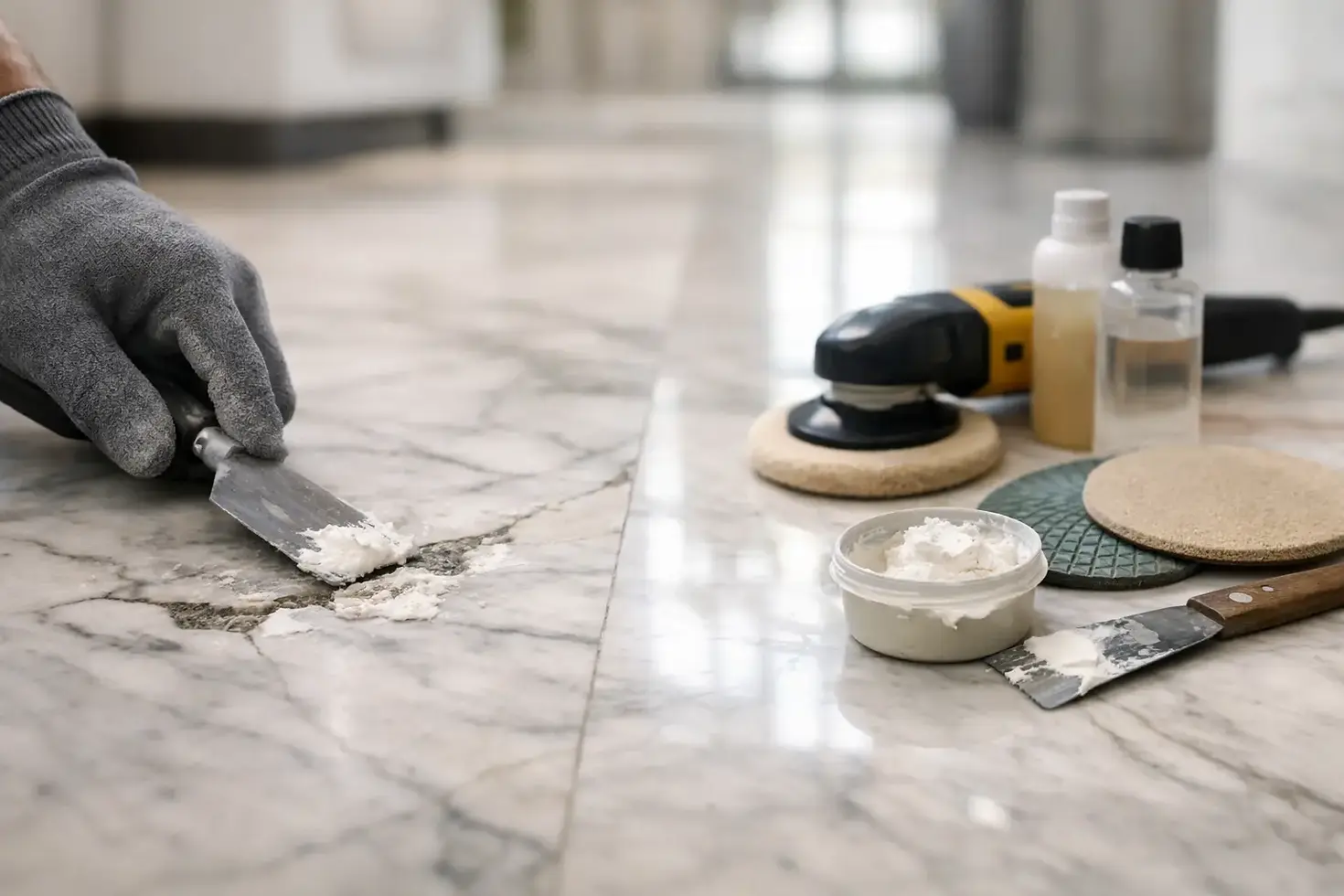
Cracks and chips may be filled with a color-matched resin or stone repair material. The repair then has to be blended into the surrounding finish so it does not stand out. This is where craftsmanship matters. A repair that is technically complete but visually obvious is not much of a restoration.
Stain treatment depends on what caused the discoloration. Some stains can be pulled out with specialty poultices or stone-safe treatments. Others may lighten but not fully disappear if the contamination has penetrated deeply or altered the stone permanently.
After correction, sealing is often recommended. Sealers do not make marble damage-proof, but they help reduce absorption and make routine maintenance easier.
When DIY repair works - and when it does not
There are minor situations where a homeowner or facility manager can improve the floor. Dry dust mopping, using a pH-neutral stone cleaner, and cleaning spills quickly all help prevent worsening damage. A small isolated scuff may also be less noticeable after proper cleaning.
But most actual marble repair is not a DIY job. Store-bought polishing powders, acidic cleaners, and general floor products often create bigger problems. Wax can leave buildup. Gloss coatings can make the floor look uneven or artificial. Harsh scrubbing can scratch the stone further. In commercial properties, the wrong maintenance approach can also create inconsistent appearance from one area to another.
The biggest mistake is trying to treat marble like tile or VCT. Marble needs stone-specific restoration methods. If the goal is to truly remove damage and restore the original finish, professional service is usually the safer and more cost-effective route.
Can dull or etched marble be restored to a high shine?
In many cases, yes. A marble floor that looks flat, cloudy, or worn can often be brought back to a clean, polished finish. The result depends on the marble type, the level of damage, and the condition of the installation, but a professional restoration can make a dramatic difference.
This is especially true when the issue is surface wear instead of deep structural damage. Etch marks, traffic patterns, and general dullness usually respond well to honing and polishing. The floor may not just look better - it can look close to its original finish again.
That said, not every floor should be restored to the highest possible gloss. In some homes or commercial spaces, a honed finish may be the better choice because it shows less wear and fits the overall look of the property. A good contractor should explain that trade-off instead of pushing one finish for every floor.
How long do marble floor repairs last?
That depends on use, maintenance, and the type of finish. A properly restored marble floor can hold its appearance for a long time, especially in residential settings with good care. In high-traffic commercial environments, wear returns faster, but professional maintenance can extend the results significantly.
The key is that repair should address the actual stone surface, not just mask it. True restoration lasts longer than temporary shine products because it corrects the problem at the material level.
Ongoing care also matters. Grit acts like sandpaper underfoot, so regular dust mopping helps. Neutral cleaners protect the finish. Entry mats reduce tracked-in debris. Fast spill cleanup matters, especially with acidic substances like juice, coffee, or cleaning chemicals.
Choosing the right marble repair specialist
Marble repair is specialized work. Not every cleaning company is equipped to handle it well. If the provider mainly offers janitorial services or general floor cleaning, that does not automatically mean they have the tools or experience to restore natural stone properly.
Look for a company that understands honing, polishing, stain treatment, chip repair, and sealer selection for marble specifically. Ask whether they restore the stone itself or rely on topical coatings. Ask what finish they recommend and why. If the floor has cracks or uneven sections, ask how they determine whether repair alone is enough.
For property owners in Tampa Bay, this matters even more in busy spaces where appearance and durability both count. A polished lobby, entry, or residential interior floor reflects on the entire property, and a poor repair tends to show quickly.
Companies like TPA Stone Care focus on stone restoration as a specialty, which is the right mindset for marble. The difference is not just in making the floor shiny. It is in understanding how to remove damage correctly, match the finish, and protect the result.
What to expect before scheduling service
A reputable contractor should evaluate the floor first, not quote blindly from a few photos. Marble can vary widely in hardness, finish, patterning, and condition. Two floors with similar dullness may need very different processes.
During an assessment, the contractor should identify whether the floor has etching, scratches, stains, chips, cracks, coating buildup, or movement-related issues. They should also explain what level of improvement is realistic. That matters because honest expectations are part of quality service.
Some floors can be restored to a near-like-new appearance. Others can be improved substantially but still retain signs of age or past damage. A trustworthy specialist will be clear about that from the start.
Marble is too valuable to write off after scratches, dullness, or stains. In many cases, the floor does not need replacement - it needs the right restoration process, done by someone who understands stone and cares about the finished result.


Comments